


Closing that distance is what this article is about. Reported settlements for a California neck injury without surgery tend to land between $10,000 and $30,000, with a national median commonly cited near $7,500. Those figures describe a crowd, not a case. Where yours falls comes down to three things:
- What your records prove, meaning documented severity and consistent treatment
- How much insurance exists to pay the claim, which is usually the real ceiling
- Which California rules apply to your file, including two that can cut a legitimate claim by more than half
What a Neck Injury Is Actually Worth in California
The published range is wide because the injuries inside it are not comparable. A stiff neck that clears in three weeks and a claim involving a year of nerve symptoms are both filed as whiplash, so any average that blends them describes nobody.
Clinical severity is the more useful lens, and the one defense medical examiners use. They apply the Quebec Task Force classification, which runs from Grade 0 through Grade 4.
| Severity | What the records show | Reported settlement range |
|---|---|---|
| Grade 1 | Pain and stiffness, no physical findings on exam | $3,000 to $10,000 |
| Grade 2 | Reduced range of motion, several weeks of physical therapy | $10,000 to $30,000 |
| Grade 3 | Neurological findings, imaging showing disc involvement | $30,000 to $100,000 |
| Grade 4 | Fracture or dislocation, permanent limitations | Usually capped by available coverage |
These are reported ranges, not promises. Every claim turns on its own records and available coverage.
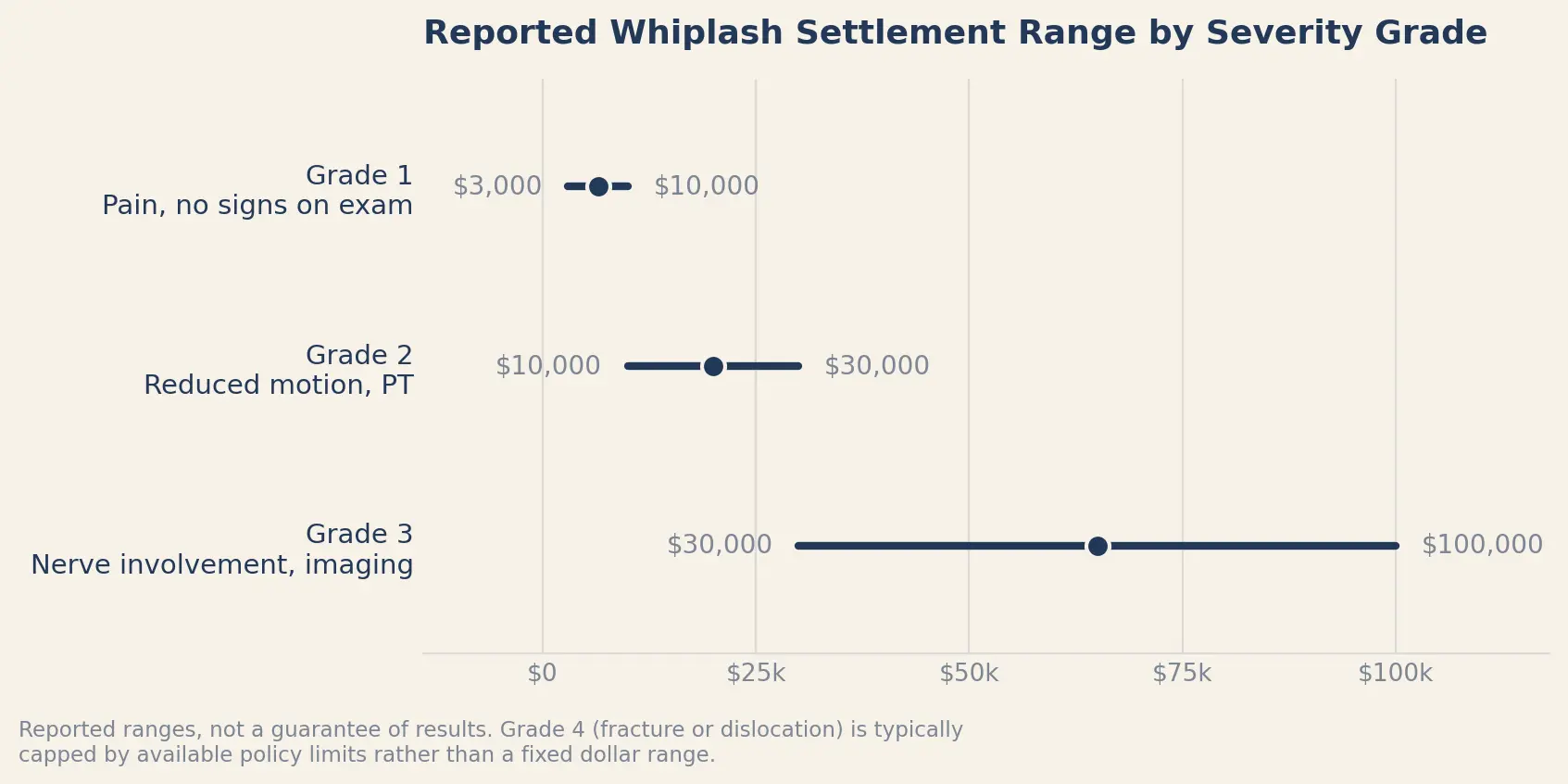
Reported whiplash settlement range by severity grade, from Grade 1 pain with no exam findings at 3,000 to 10,000 dollars, to Grade 3 nerve involvement at 30,000 to 100,000 dollars
Look again at the last row. In most cases the ceiling is not the injury but the at-fault driver’s policy, and that ceiling recently moved. Under Senate Bill 1107, California’s minimum bodily injury coverage rose on January 1, 2025 to $30,000 per person and $60,000 per accident, up from $15,000 and $30,000, phasing in as policies renew. If the driver who hit you carries the minimum, that is what their side can pay.
Your own policy is the second place to look. Underinsured motorist coverage, under California Insurance Code Section 11580.2, pays the gap between the other driver’s limits and what the claim is worth. Most people never learn they can file against their own insurer, and that coverage is often the difference between a capped offer and a real recovery.
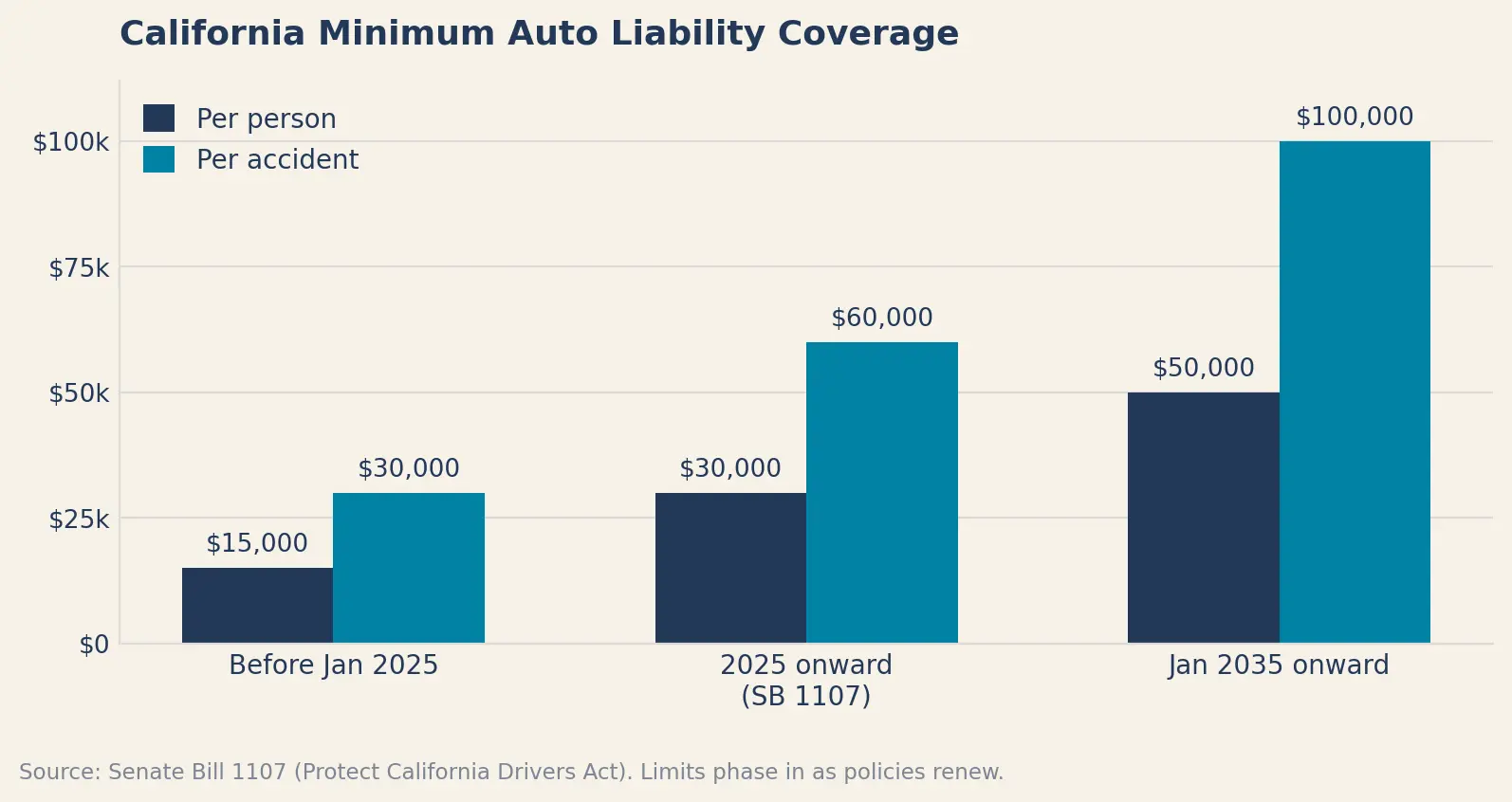
California minimum auto liability coverage per person and per accident, rising from 15,000 and 30,000 dollars before January 2025 to 30,000 and 60,000 dollars under Senate Bill 1107, then to 50,000 and 100,000 dollars starting January 2035
Not sure how much coverage actually applies to your crash? A free case review can pin down what the other driver’s policy pays and whether your own underinsured motorist coverage fills the gap. Request a free consultation →(949) 535-1341
What Moves the Number Up or Down
Medical documentation does most of the work. Grade 2 is where the majority of these cases sit, and it is also where paperwork matters most, because there is no fracture on an x-ray to argue about. Four things carry genuine weight with an adjuster:
- Objective findings on examination, particularly measured loss of range of motion
- A completed course of physical therapy, which is why people ask whether therapy raises a settlement. It tends to, not because sessions add up, but because attendance records prove the injury was real and treated
- Imaging that shows something, such as a bulging or herniated disc, which moves a file out of the minor category entirely
- A specialist referral, since an orthopedist or neurologist carries more weight than a single urgent care note
The list works in reverse. Symptoms commonly surface two or three days after impact, which is medically ordinary, but a ten day gap before the first appointment invites the argument that something else caused the injury. Missed appointments read the same way, as does stopping early.
Head symptoms deserve their own mention. Rear-end impacts often produce concussion symptoms alongside neck pain, and headaches, fogginess, and light sensitivity belong in front of a physician, because a documented concussion changes the character of a claim entirely. Liability matters as well. Rear-end collisions carry a strong presumption of fault in California, but presumption is not proof, and the collision report, black box data, and an independent witness are what make it unarguable.
Three California Rules That Change the Math
Here is where a California claim parts company with the national averages people find online.
Your medical bills are worth what was paid, not what was billed. In Howell v. Hamilton Meats, the California Supreme Court held that past medical damages are limited to the amount actually paid and accepted by the provider. A $14,000 chiropractic bill negotiated down to $4,200 anchors the claim at $4,200, and because general damages are negotiated in relation to medical specials, the reduction drags everything else down. This one rule explains most of the gap between what people expect and what they are offered.
If you were uninsured, you may lose pain and suffering entirely. Civil Code Section 3333.4, passed by voters as Proposition 213, bars uninsured owners and operators, along with drivers convicted of drunk driving, from recovering non-economic damages. Medical bills, lost wages, and property damage stay fully recoverable, but pain and suffering is usually the larger half of such a claim, so the effect is severe. The exceptions matter as much as the rule. Proposition 213 does not bar you if:
- You were a passenger rather than the owner or operator
- You were driving with permission and covered under someone else’s policy
- You were an employee driving your employer’s uninsured vehicle
- You are an heir bringing a wrongful death claim
- You were an uninsured owner injured by a driver who was actually convicted of drunk driving
The clock is shorter than you think. Code of Civil Procedure Section 335.1 allows two years from the date of injury to file suit. If a city vehicle, transit bus, or public works truck was involved, Government Code Section 911.2 requires an administrative claim within six months, and missing that deadline generally ends the case regardless of merit.
One myth deserves retiring while we are here. California does not cap pain and suffering in car accident cases. The well known cap applies to medical malpractice claims only.
Partial fault is less damaging than most people assume. California follows pure comparative negligence, so being found twenty percent responsible on a $30,000 claim means recovering $24,000 rather than nothing. The reduction never appears on the check, which is exactly why adjusters assign more fault to soft tissue claimants than the evidence supports.
One of these rules could be cutting your claim in half. Talk to an attorney before you sign anything. Call (949) 535-1341
How Insurers Price These Claims, and How You Get Paid
Low speed collisions are often routed into a minor impact track built to close files quickly, and the argument that arrives with it is familiar: the bumper looks fine, so the injury cannot be serious.
Vehicle damage is a poor proxy for the forces inside the cabin. When the Insurance Institute for Highway Safety analyzed more than 600,000 rear-impact insurance claims, it found that seats with good head restraints reduced injury rates by eleven percent compared with poor ones. These injuries turn on seat geometry and occupant position, not cosmetic damage.
You are also under no obligation to give the other driver’s insurer a recorded statement. Symptoms often worsen through the first week, and a cheerful “I feel fine” recorded on day two will be read back to you during negotiation.
Timing is set by treatment, not paperwork. Most claims resolve within three to nine months, and settling before your condition stabilizes means settling before anyone knows the value, with no way to reopen it. California does hold insurers to real deadlines. Under Title 10, Section 2695.7 of the California Code of Regulations, a carrier must accept or deny within forty calendar days of receiving proof of claim and tender payment within thirty calendar days of accepting the claim and receiving your signed release.
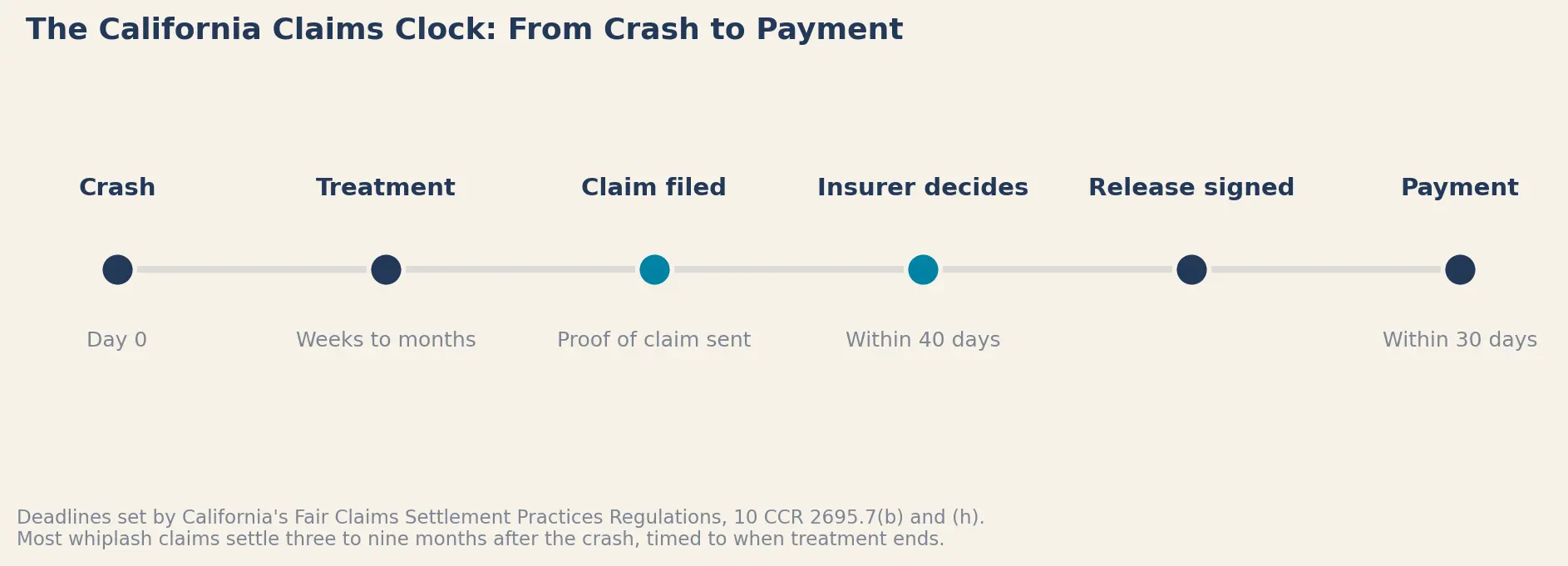
Timeline of a California whiplash claim from the crash through treatment, claim filing, the insurer’s decision within 40 days, the signed release, and payment within 30 days
Once you sign, the money moves in a set order:
- The insurer issues a check payable to you and your firm
- It is deposited into the firm’s client trust account
- The contingency fee and case costs are deducted
- Medical liens and outstanding balances are negotiated and paid
- The remainder is disbursed to you, usually within a few weeks
Step four is quiet but consequential. Hospital liens, Medi-Cal reimbursement, health plan claims, and providers who treated on a lien all reach into the settlement, and negotiating those balances down is frequently where an attorney adds the most to what you keep.
Talk Through Your Claim Before You Answer the Adjuster
Every claim is different. What matters is not what someone else received, but which of these rules applies to your file and how much coverage exists to pay it.