

That jump leaves most drivers asking one question: how long does an accident stay on your insurance? In California, the answer is usually about three years. The good news is that you have more control over the cost than you might think.
California also has rules that most national websites skip. Proposition 103 limits when insurers can charge you more after a crash, and fault matters a great deal. At Kohan & Bablove Injury Attorneys, we see how these rules play out for real drivers in Orange County and Riverside. This guide covers the timeline, where your accident is recorded, and seven ways to keep your rates down.
How Long Does an Accident Stay on Your Insurance in California?
In California, an at-fault accident usually affects your car insurance for about three years. Insurers generally look back three years when they set rates, and the state’s Good Driver rules use the same window. The claim can stay in an industry database for seven years.
Treat three years as a general rule, not a promise. Each insurer sets its own look-back period, and some stretch it to five years. Many companies also check your record at renewal, so the change often shows up on your next bill, not the week after the crash. If your crash happens in March and your policy renews in September, the surcharge may start in September and run until the accident passes the three-year mark.
How Long Does a Car Accident Stay on Your Record? Three Places to Check
Your accident does not live in just one file. Three separate records can affect your rates, and each has its own timeline.
| Record | Who keeps it | How long it usually lasts | What it affects |
| DMV driving record | California DMV | About 3 years for most accidents and minor violations | License status and what insurers see |
| Insurer look-back | Your insurance company | About 3 years in California, though it varies | Your premium and Good Driver Discount |
| CLUE claims report | LexisNexis | 7 years | Quotes from new insurers |
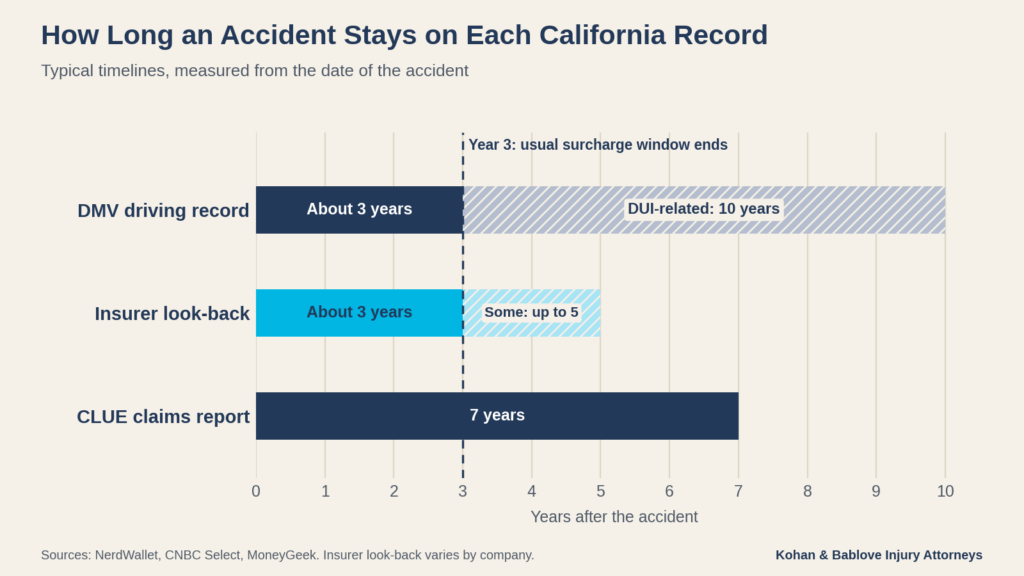
The DMV keeps most accidents and minor violations for about three years, while a DUI conviction stays for 10. Your insurer keeps its own file and decides how far back to look. Claims also go to a national database called CLUE, run by LexisNexis, which holds seven years of claims history.
This is why an accident can follow you to a new insurer even after your current company stops charging you for it. You can request your own DMV record and your free CLUE report to see exactly what insurers see. Your legal duty to report a crash is a separate question. We explain it in our guide on reporting an accident to the DMV in California.
Does Fault Change How Long an Accident Affects Your Rates?
Yes. In California, insurers generally can raise your rates only when you were principally at fault, meaning more than half responsible. If another driver caused the crash, Proposition 103 should protect you from a surcharge, even though the claim may still appear in your records.
California voters passed Prop 103 in 1988. It tells insurers to price policies mainly on three things: your driving record, how many miles you drive, and your years of experience. Driving record carries the most weight.
The Good Driver Discount, worth 20 percent, also depends on fault. To qualify, you generally cannot have been principally at fault in a crash that caused injury, death, or more than $1,000 in property damage during the past three years. The dollar threshold can change, so confirm the current figure with your insurer.
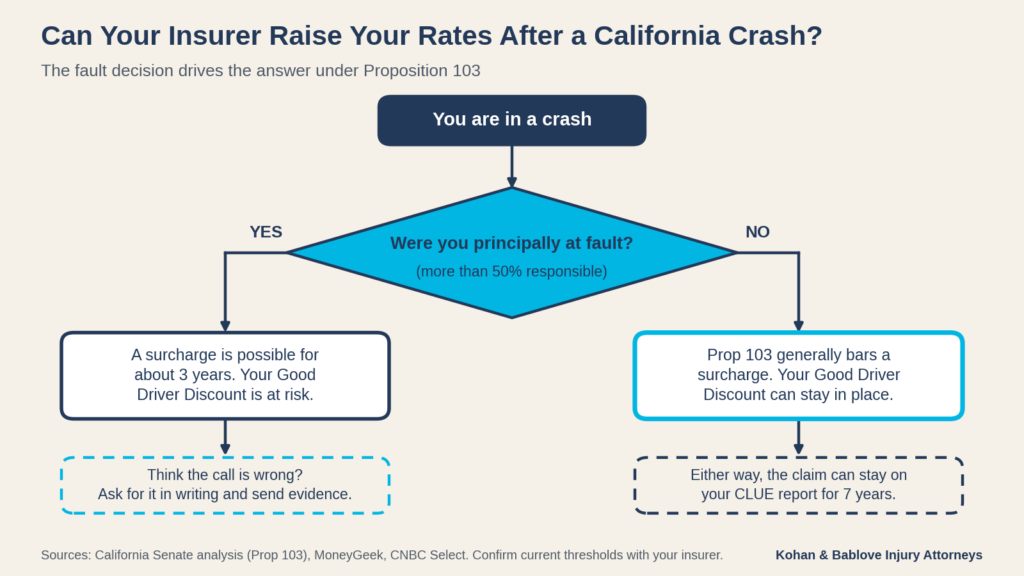
Here is how the two outcomes compare:
| You were principally at fault | You were not principally at fault | |
| Rate surcharge | Likely, for about 3 years | Generally not allowed under Prop 103 |
| Good Driver Discount | Usually lost for about 3 years | Generally stays in place |
| CLUE report | Claim stays 7 years | Claim still stays 7 years |
| Best next step | Compare quotes and keep your record clean | Keep your evidence and confirm the fault label is correct |
Insurers decide fault by reviewing the police report, photos, driver and witness statements, and traffic laws. They do not need a court ruling. That is different from an injury claim, where California’s pure comparative negligence rule lets you recover damages even if you share some blame. A small share of fault can lower your injury payout without triggering a surcharge, and both questions rest on the same evidence.
That is why fault disputes matter so much. If your insurer says you were 51% to blame and the evidence points to 30%, that gap can cost you for three years.
Did your insurer blame you for a crash you did not cause? Kohan & Bablove Injury Attorneys can review the evidence and explain your options. Call (949) 535-1341 for a free case review. You pay no fees until you get paid.
How Much Does Insurance Go Up After an Accident?
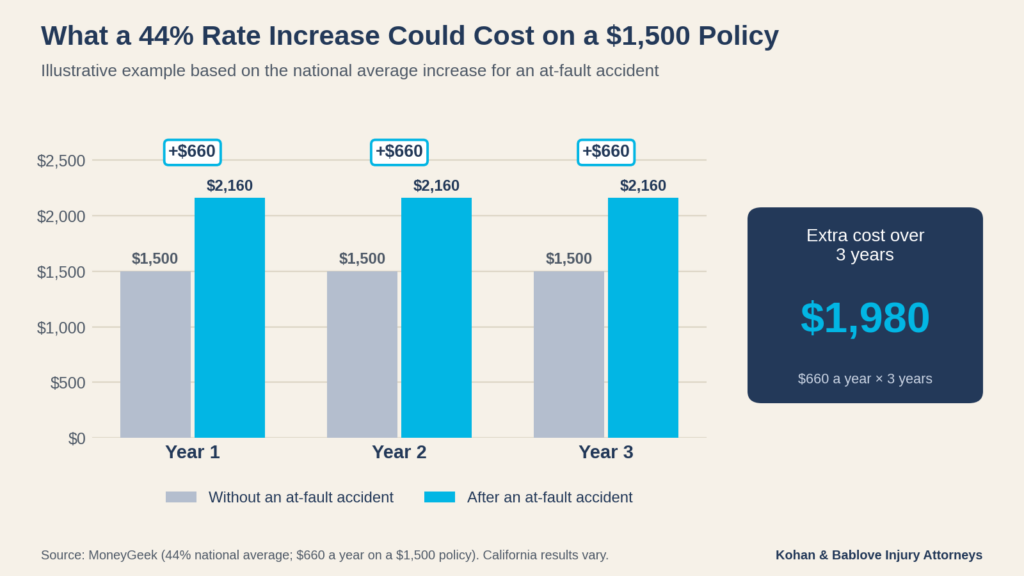
There is no single number for California. A national MoneyGeek analysis found that at-fault accidents raise rates by 44 percent on average, or about $660 a year on a $1,500 policy.
Companies also treat the same accident very differently. One insurer might add 45 percent while another adds 25 percent. Your age, location, and coverage change the result too, which is why comparing quotes pays off.
Over a three-year window, that national figure adds up to nearly $2,000, which is why a wrong fault label deserves a second look.
7 Ways to Limit the Rate Increase
You cannot erase an accurate accident from your records. You can often shrink what it costs you. Here is how to lower car insurance after an accident, starting with the step that matters most: getting the fault decision right.
1. Find Out How Your Insurer Decided Fault
Ask your insurer in writing whether it labeled the accident “at fault” and why. Request the police report number, photos, and statements it relied on. Many drivers never ask, and they pay a surcharge for years because of a quick judgment call.
2. Dispute a Fault Decision That Looks Wrong
If the facts do not match, send your own evidence: photos, dashcam video, witness names, and the police report. If the insurer will not review it, you can file a complaint with the California Department of Insurance. Our article on signs your insurer is not treating you fairly shows what to watch for.
3. Let the At-Fault Driver’s Insurer Pay
When someone else caused the crash, make your claim against their policy. California rules are built to keep not-at-fault drivers from being surcharged. Before you choose which policy pays for repairs, talk with a lawyer, because that choice can affect your injury claim.
4. Compare Quotes Before Renewal
Insurers weigh accidents differently, so the same history can cost far less elsewhere. Get at least three quotes a few weeks before your renewal date. Answer every question honestly. Insurers pull your claims history anyway, and a mismatch can cause bigger problems.
5. Ask for Every Discount You Qualify For
Ask about each discount by name: Good Driver, low mileage, bundling with home or renters coverage, safety features, and approved driving courses. Miles driven is one of California’s three main rating factors. If you now drive less, an accurate, lower mileage estimate can help.
6. Adjust Your Deductible, Not Your Protection
A higher deductible lowers your premium, but you pay more if you file another claim. Raise it only if you could cover that amount tomorrow. Do not cut liability or uninsured motorist coverage to save money. One serious crash can cost far more than you saved.
7. Keep Your Record Clean While the Clock Runs
Avoid tickets and new claims for the next three years. Traffic school can remove a point for a moving violation, but it will not erase an accident. A clean three years is what usually opens the door to the Good Driver Discount again.
Not sure how your insurer decided fault? Send us the details, and our team will explain where you stand. Contact Kohan & Bablove to request your free case review online.
Mistakes That Make the Increase Worse
A few common missteps can raise your costs or weaken your position:
- Waiting to tell your insurer. Most policies require prompt notice, and a late report can cause bigger problems than a surcharge.
- Apologizing at the scene. Words like “I’m sorry” can end up in an insurer’s file as an admission.
- Guessing about fault in a recorded statement. Stick to facts you know firsthand.
When Will Your Rates Come Down?
Rates rarely drop on a set day. Many insurers lower your premium at the first renewal after the accident passes the three-year mark. Call a few weeks before that date and ask for your policy to be re-rated.
Here is a simple way to picture the timeline:
- Years 0 to 3: The accident can raise your rate and block the Good Driver Discount.
- Around year 3: Ask your insurer to re-rate your policy.
- Year 7: The claim is removed from your CLUE report.
Also order your free CLUE report from LexisNexis and read it line by line. Errors can keep your rates high. If you find one, you can dispute it with LexisNexis.
Get a Free Case Review Before Your Rates Go Up
An accident can follow you for three years, but a wrong fault call should not. If your insurer is blaming you for a crash someone else caused, get help early. The longer a bad finding stays on file, the harder it is to change.
Our California car accident lawyers offer a free consultation, and you pay no fees until you get paid. Call (949) 535-1341 or request your free case review online today.