Se Habla Español | We Speak Tagalog | (949) 535-1341 | 20371 Irvine Ave., Suite 110, Newport Beach, CA 92660
No fees until you get paid

Introduction

Imagine surviving a devastating pedestrian accident, enduring six surgeries, and fighting to rebuild your life, only to have the driver who caused it all refuse to take responsibility.

That is exactly what our client faced. And it is not as uncommon as it should be.

Pedestrian accident victims are often targeted by insurance companies looking for a fast, cheap resolution. Insurers know that an unrepresented victim is far easier to lowball than one backed by an experienced pedestrian accident lawyer. Their strategy is simple: move quickly, offer little, and close the claim before the full picture of a victim’s suffering and losses comes into focus.

At Kohan & Bablove, we refused to let that happen. By deploying private investigator surveillance, conducting a thorough asset discovery investigation, and proving liability early, we secured a $3 million pre-litigation settlement for our client in just 12 months, without ever setting foot in a courtroom. At the time, it was the largest pre-litigation settlement in our firm’s history.

This is how we did it.


The Challenge: Catastrophic Injuries and a Denied Liability Claim

The Physical and Emotional Toll

Our client’s life changed in an instant. The impact of the pedestrian accident left her with multiple fractures requiring six separate surgeries to stabilize and repair. Her physical recovery was long, painful, and ongoing. But for many catastrophic injury survivors, the emotional weight can be just as debilitating as the physical damage. Living with uncertainty, not knowing whether justice will ever come, adds a layer of suffering that no settlement figure can fully capture.

What made her situation even more difficult was the defendant’s response. Despite the clear and serious nature of the crash, the at-fault driver flatly refused to admit fault. For our client, that denial was not just a legal obstacle. It felt like a personal injustice, as she was being forced to fight for her dignity and her future at the very moment she needed to focus on healing.

The Insurance Company’s Strategy

Shortly after the accident, once the insurer recognized the potential magnitude of the damages, they moved quickly, but not in our client’s favor. The insurance company pushed hard for early mediation, presenting it as a cooperative path toward resolution. In reality, it was a calculated tactic designed to limit their financial exposure.

Here is why: before a formal lawsuit is filed, the opposing side is not legally required to hand over internal communications, phone records, or dashcam footage. The insurance company understood this procedural reality and tried to use it as leverage. By keeping critical evidence out of reach, they hoped to pressure our client into accepting a settlement far below what her catastrophic injuries and suffering actually warranted. They were counting on her desperation and exhaustion to do the work for them.

  We had other plans.


The Strategy: Building Leverage Through Investigation

If They Will Not Give Us the Evidence, We Find It Ourselves

Kohan & Bablove injury attorneys are not a firm that waits. Rather than accepting the limitations of the pre-litigation phase, we immediately launched our own independent investigation.

Our team hired a private investigator surveillance team to physically canvas the area where the pedestrian accident occurred. We were not waiting for the defendant’s cooperation or the insurance company’s timeline. We were looking for the truth, and we found it.

Our investigators identified third-party security cameras from nearby businesses that had been overlooked by both the police and the insurance adjusters. The footage was unambiguous. It captured the collision in clear detail and established that the defendant was entirely at fault. With that evidence in hand, the defense could no longer deny liability. We had not relied on their records or their cooperation. We had built our case independently, and it was airtight.

Asset Discovery: Ensuring the Defendant Could Pay

Proving fault is only one part of securing meaningful compensation for a catastrophic injury. In cases involving severe damages, a standard insurance policy limit is often not enough to cover a client’s full losses. Our team knew we had to look deeper.

We conducted a comprehensive asset discovery investigation to evaluate the defendant’s full financial picture beyond their basic coverage. What we found was significant. The defendant had substantial financial resources that had not been disclosed upfront. This was the final piece of leverage we needed.

By combining undeniable video evidence of liability with documented proof of the defendant’s assets, we put the insurance company in an impossible position. They knew that if this case went before a jury, the outcome would almost certainly exceed anything they had offered. The risk of going to trial was simply too great.


The Outcome: A $3 Million Pre-Litigation Settlement in 12 Months

A Historic Result for Our Client

With liability proven on camera and asset discovery confirming the defendant’s ability to pay, the defense’s strategy collapsed. Kohan & Bablove successfully negotiated a $3,000,000 settlement within 12 months of the pedestrian accident, without filing a lawsuit.

At the time, this stood as the single largest pre-litigation settlement in our firm’s history. Achieving this level of catastrophic injury compensation outside of a courtroom is rare. It is a direct result of aggressive preparation, proactive investigation, and an unwillingness to accept anything less than full value for our client’s suffering.

What This Meant for Our Client

Beyond the financial outcome, what mattered most to our client was that she never had to relive the trauma of her accident on a witness stand. She did not have to endure years of litigation while still recovering from her injuries. Instead, she received the justice she deserved in under a year, allowing her to close this painful chapter and focus entirely on her recovery and her family.

Throughout the process, the Kohan & Bablove team maintained constant communication, answering every question and providing steady reassurance during one of the most difficult periods of her life. She was never left to navigate this alone.

Securing this pre-litigation settlement was not just about winning a case. It was about protecting our client’s future and her well-being from the very first conversation to the final resolution.


Conclusion: Proactive Advocacy Makes the Difference

Many law firms wait for the formal discovery process to unfold before building their case. Kohan & Bablove takes a different approach. We go out and find the evidence ourselves. We investigate assets. We refuse to let insurance companies control the timeline or dictate the value of our clients’ suffering.

In this case, that proactive approach turned a completely denied liability claim into a $3 million victory for a pedestrian accident victim who deserved so much better than what the insurance company was willing to offer.

The difference between a lowball offer and a life-changing settlement often comes down to the determination and resources of your legal team. If you are dealing with serious injuries while an insurance company drags its feet, you deserve a firm that will fight for your future with everything available to it.

 Contact Kohan & Bablove Injury Attorneys today for a free consultation. Let us build the leverage you need to maximize your recovery.


Texas car accident statistics reveal a sobering reality for drivers, passengers, and pedestrians across the state. Despite improvements in vehicle safety and enforcement, Texas continues to report thousands of fatalities and hundreds of thousands of injuries each year. Understanding these trends is not just about data. It is essential for identifying liability, strengthening personal injury claims, and protecting your legal rights.

In this research-driven guide, we break down the latest Texas crash data, uncover key trends, analyze leading causes, and explain the legal implications for accident victims. Whether you are a driver, policymaker, or injury victim, these insights provide a clear, evidence-based understanding of roadway risks in Texas.


Overview of Car Accident Data in Texas

Texas consistently ranks among the states with the highest number of motor vehicle accidents in the United States. According to the Texas Department of Transportation, the scale of traffic incidents remains alarming even in years with slight improvements.

In 2024 alone, Texas reported:

  • 4,150 fatalities, a 3.29% decrease from 2023
  • 251,977 injuries from traffic crashes
  • One crash every 57 seconds
  • One injury every 2 minutes and 5 seconds
  • One death every 2 hours and 7 minutes

These figures highlight that car accidents are not isolated incidents. They are a constant and systemic issue affecting millions of Texans.

Additionally, Texas recorded over 513,000 crashes in 2024, demonstrating the sheer volume of roadway incidents across urban and rural areas . The state’s large population, extensive highway network, and high vehicle miles traveled contribute significantly to these numbers.

Another key metric is the fatality rate, which stood at 1.35 deaths per 100 million vehicle miles traveled in 2024. While this reflects a slight improvement, it still indicates substantial risk exposure for drivers.

From a legal standpoint, these numbers matter because they establish patterns of negligence, risk factors, and systemic hazards. Courts and insurance companies often rely on such data to evaluate claims, determine liability, and assess damages.


Year-by-Year Trend Analysis

Understanding Texas car accident statistics requires analyzing how trends evolve over time. While some metrics show improvement, others reveal persistent risks.

Between 2023 and 2024:

  • Fatalities decreased from 4,291 to 4,150
  • Fatality rate declined by 5.25%
  • Vehicle miles traveled increased by 2.07%

This creates a paradox. While roads are statistically becoming slightly safer per mile, total exposure is increasing, which keeps overall fatalities high.

Fatalities vs Non-Fatal Accidents

The vast majority of accidents in Texas are non-fatal, but the injury burden is massive. In 2024:

  • Over 251,000 injuries occurred
  • 18,218 serious injuries were reported

This means that for every fatal accident, there are dozens of life-altering injury cases. From a personal injury perspective, non-fatal crashes often result in long-term medical costs, lost wages, and diminished quality of life.

Moreover, serious injury crashes (14,905 incidents) indicate a high frequency of severe collisions. These cases frequently involve complex litigation due to higher damages and disputed liability.

Urban vs Rural Accident Rates

One of the most critical insights in Texas crash data is the urban-rural divide.

  • 50.1F% of fatalities occur in rural areas
  • 2,080 deaths occurred on rural roads in 2024

Rural accidents tend to be more severe due to:

  • Higher speed limits
  • Limited lighting
  • Delayed emergency response times

Additionally, single-vehicle run-off-road crashes accounted for 32.6% of fatalities, many of which occur in rural settings.

From a legal standpoint, rural accidents often involve different liability considerations, including road design, maintenance issues, and delayed medical intervention.


Leading Causes of Accidents

Identifying the leading causes behind crashes is essential for both prevention and legal analysis. Texas data consistently highlights a few dominant factors.

The most common causes of accidents in 2024 include:

  • Speeding (135,053 crashes)
  • Distracted driving (86,798 crashes)
  • Unsafe lane changes (52,691 crashes)
  • Failure to yield and traffic violations

For fatal crashes, the leading contributors include:

  • Failure to maintain lane
  • Drunk driving
  • Speeding
  • Unsafe driving behaviors

Additionally, alcohol-related crashes remain a major issue, accounting for 25.37% of all fatalities in 2024 .

Distracted driving also caused 380 deaths in 2024, underscoring the dangers of mobile device usage .

From a legal perspective, these causes directly translate into negligence claims. For example:

  • Speeding → breach of duty of care
  • Drunk driving → negligence per se
  • Distracted driving → reckless behavior

Establishing causation is a critical element in personal injury lawsuits, and these statistics often serve as supporting evidence.


Demographic Risk Factors

Texas crash data also reveals important demographic trends that influence accident risk.

Key insights include:

  • Male drivers are disproportionately involved in fatal crashes (national and regional trends)
  • Younger drivers face higher accident rates due to inexperience
  • Older drivers may have higher fatality risk due to physical vulnerability

Additionally, vulnerable road users face elevated risks:

  • 768 pedestrian deaths in 2024
  • 78 bicyclist fatalities

Motorcyclists are also at high risk:

  • 585 motorcyclist fatalities in 2024
  • 37% were not wearing helmets

These statistics highlight how risk is not evenly distributed across populations.

Legally, demographic factors may influence:

  • Comparative fault arguments
  • Duty of care standards
  • Jury perception in injury cases


Economic Impact of Car Accidents

The economic consequences of car accidents in Texas extend far beyond immediate damages. While exact annual cost figures vary, the cumulative impact includes:

  • Medical expenses (emergency care, surgery, rehabilitation)
  • Lost wages and reduced earning capacity
  • Property damage
  • Insurance costs and premium increases

The Texas Department of Transportation also tracks economic loss associated with crashes, which reaches billions annually when factoring healthcare, productivity, and property damage .

Additionally, increased vehicle miles traveled (307 billion miles in 2024) further amplifies economic exposure .

From a legal standpoint, economic damages form the backbone of personal injury claims. Plaintiffs may recover:

  • Medical costs (past and future)
  • Lost income
  • Property repair costs

In severe cases, claims may also include non-economic damages, such as pain and suffering, emotional distress, and loss of enjoyment of life.


Legal Implications of These Trends

The trends in Texas car accident statistics have direct legal consequences for both plaintiffs and defendants.

1. Negligence and Liability

Most car accident cases are based on negligence, which requires proving:

  • Duty of care
  • Breach of duty
  • Causation
  • Damages

Statistics showing common causes like speeding or drunk driving strengthen negligence claims.

2. Comparative Fault in Texas

Texas follows a modified comparative fault rule (51% bar rule). This means:

  • You can recover damages if you are less than 51% at fault
  • Compensation is reduced by your percentage of fault

Accident data helps establish fault distribution in disputed cases.

3. Negligence Per Se

Certain violations, such as DUI, may qualify as negligence per se, meaning liability is presumed if the violation caused the accident.

4. Evidence and Litigation Strategy

Law firms often use crash statistics to:

  • Demonstrate foreseeable risks
  • Support expert testimony
  • Strengthen settlement negotiations


What This Means for Injury Claims

For injury victims, these statistics are more than numbers. They directly influence how claims are evaluated and resolved.

Key Takeaways for Claimants:

  • High accident frequency strengthens the argument that risks are well-known
  • Common causes like speeding make liability easier to prove
  • Injury prevalence supports higher compensation claims

Victims should act quickly to:

  • Gather evidence
  • Seek medical treatment
  • Consult a personal injury attorney

Insurance companies often rely on statistical trends to minimize payouts. However, experienced attorneys use the same data to maximize compensation.

Internal Link Suggestions:

  • Personal Injury Services Page
  • Car Accident Lawyer Texas Page
  • Wrongful Death Claims Guide

External Link Suggestions:

  • Texas Department of Transportation Crash Reports
  • National Highway Traffic Safety Administration (NHTSA)


Conclusion

Texas car accident statistics paint a clear and compelling picture of roadway risk across the state. Despite modest improvements in fatality rates, the total number of crashes, injuries, and deaths remains alarmingly high. With over 4,000 fatalities and hundreds of thousands of injuries annually, traffic accidents continue to impact individuals, families, and communities at scale.

The data also reveals consistent patterns. Speeding, distracted driving, and impaired driving remain leading causes, while rural areas account for a disproportionate share of fatalities. These trends highlight not only the dangers on Texas roads but also the importance of accountability and legal protection.

For injury victims, understanding these statistics is critical. They provide the foundation for proving negligence, calculating damages, and pursuing fair compensation. Whether negotiating with insurers or litigating in court, data-driven insights strengthen every aspect of a personal injury claim.

A dog bite is a deeply traumatic experience, leaving victims with both physical and emotional scars. If this has happened to you or a loved one in Riverside County, it’s important to know that California law is on your side. The state follows a “strict liability” rule, which means a dog owner is almost always responsible for the harm their dog causes, even if the dog has never been aggressive before.

However, a successful dog bite claim in Riverside County involves more than just state law. Local ordinances regarding leash laws, containment, and reporting play a crucial role in proving negligence and maximizing your compensation. Understanding how these specific county rules supplement state law is essential. At Kohan & Bablove Injury Attorneys, we specialize in using this local knowledge to build the strongest possible case for our clients, ensuring you receive the justice and support you deserve.

Introduction: How Local Rules Supplement California’s Strict Liability Law

While California’s strict liability law provides a powerful foundation for dog bite victims, Riverside County’s local ordinances add another crucial layer of protection and proof. State law holds an owner automatically accountable for the bite itself when it occurs in a public place or lawfully on private property. However, local rules define the owner’s day-to-day responsibilities, like mandatory leash use in public parks, secure fencing requirements, and special handling for dogs deemed “potentially dangerous.”

When an owner violates one of these specific local ordinances, it provides clear, documented evidence of negligence that goes beyond the bite alone. It demonstrates a direct failure to follow community safety standards designed to prevent such attacks from ever happening. At Kohan & Bablove Injury Attorneys, we expertly weave these county-specific rules into your claim to build an undeniable case for accountability and secure the compensation you are owed.

Key Riverside County Animal Control Ordinances

To successfully pursue a dog bite claim, it is essential to look beyond the injury itself and examine whether the dog owner violated specific local regulations. Riverside County has established detailed ordinances to ensure public safety, and when an owner fails to follow these rules, it provides powerful evidence of negligence that can significantly bolster your personal injury case.

Leash Law Requirements (Ordinance No. 6.08)

One of the most critical regulations in Riverside County is the prohibition against dogs running “at large.” Under County Ordinance No. 6.08, dog owners are legally required to keep their pets under direct physical restraint, typically a leash not exceeding six feet in length, whenever they are on public property or in unfenced common areas. This rule is designed to prevent unprovoked attacks on pedestrians, joggers, and other pets. If you were bitten by a dog that was roaming freely in a public space, the owner is in clear violation of this ordinance. This violation serves as powerful leverage during settlement negotiations, as it demonstrates an undeniable failure to exercise the required duty of care.

Declaring a Dog “Potentially Dangerous” or “Vicious”

Riverside County Animal Services enforces a specific classification system for dogs with a history of aggression. A dog may be legally designated as “potentially dangerous” if it has previously behaved aggressively or forced a person to take defensive action. A more severe classification, “vicious,” applies to dogs that have inflicted serious injury on a human or killed another domestic animal. This history is vital for your attorney to investigate. If the dog that bit you had already been flagged by the county, the owner was officially on notice of the risk. Proving an owner knowingly kept a dangerous animal without proper safeguards can sometimes open the door to higher compensation for your injuries.

Owner Responsibilities for Containment

Even when a dog is on private property, the owner has a strict legal obligation to prevent it from escaping. Local ordinances require that dogs be kept in a securely enclosed area, such as a fenced yard or a kennel, that prevents them from wandering onto sidewalks or neighboring properties. A simple “Beware of Dog” sign is not enough to absolve an owner of liability. If a dog jumps a fence, digs under a gate, or pushes through a loose latch to attack someone, the owner has failed their responsibility. At Kohan & Bablove Injury Attorneys, we inspect the property conditions to prove that the owner’s negligence in securing their pet directly led to your injuries.

How Violating a Local Ordinance Can Prove Negligence

In California, dog bite cases are generally governed by “strict liability,” meaning the owner is responsible even if they weren’t careless. So why do local ordinance violations matter? Because proving the owner also broke a specific safety rule, like a leash law, adds a layer of clear, documented negligence that strengthens your claim. It makes it much harder for insurance companies to argue that the attack was unavoidable or that you were partially at fault.

Using an “off-leash” violation as evidence

One of the most powerful tools in a dog bite claim is showing that the owner violated Riverside County’s leash law. If the attack occurred in a public park, on a sidewalk, or any area where dogs must be restrained, the owner was acting illegally. A police or animal control report documenting this violation provides indisputable proof of negligence. At Kohan & Bablove Injury Attorneys, we use this evidence to establish a clear breach of the owner’s duty to protect the community, which strengthens our demand for full and fair compensation.

Checking for prior complaints with Animal Services

A critical step in our investigation is uncovering the dog’s history of aggression. We file official requests with Riverside County Animal Services to identify prior complaints, bite reports, or “potentially dangerous” classifications. If records show the owner had been warned about their dog’s behavior, it proves they were “on notice” of the risk. This evidence demonstrates a conscious disregard for public safety and can be used to pursue maximum damages for the injuries you suffered.

Steps to Take After a Dog Bite in Riverside

The moments following a dog attack can be chaotic and frightening, but what you do immediately afterward can greatly impact both your health and any potential legal claim. Your first priority is your well-being, seek medical attention right away, even if the wound appears minor. Dog bites carry a high risk of infection and require professional care. Once safe, begin documenting everything: take clear photos of your injuries, the dog (from a safe distance), and the attack location, noting broken fences or gates. Collect contact information for the dog’s owner and any witnesses. These steps create a factual record crucial for protecting your rights.

Reporting the Bite to Riverside County Animal Services

Filing an official report with Riverside County Animal Services is a critical legal step. This isn’t just a formality, it creates an independent, government-backed record of the incident. The report should include the dog’s description, the owner’s information, the exact location, and the severity of your injuries. Submitting this report prompts an investigation into the dog’s vaccination status (especially rabies) and determines if the animal needs to be quarantined or classified as dangerous. This documentation becomes a cornerstone of your personal injury claim. At Kohan & Bablove Injury Attorneys, we rely on these official records to substantiate facts and hold negligent owners fully accountable.

How Kohan & Bablove Uses Local Knowledge to Your Advantage

Filing a dog bite claim requires more than just knowing California law, it demands intimate familiarity with the local legal landscape. At Kohan & Bablove Injury Attorneys, our deep understanding of Riverside County’s specific ordinances and animal control procedures gives clients a decisive advantage. We know which local rules to cite, how to quickly obtain prior complaint records, and how to anticipate and counter the tactics used by insurance adjusters who handle these claims every day.

This hyper-local expertise allows us to build a compelling case for negligence, positioning you to secure the maximum compensation for medical bills, lost wages, and recovery. While other firms may focus solely on state law, we see the full picture. We turn our local knowledge into your legal advantage, fighting for the justice you deserve while you focus on healing.

The chaos of a car crash is made worse when the other driver flees. For victims of hit-and-run accidents in Riverside, this creates a feeling of frustration and uncertainty. You’re left with injuries and damages, wondering how you will cover your medical bills and repairs.

Fortunately, you may have options through your own auto insurance policy, specifically through an uninsured motorist claim. Navigating this process can be complex, and it’s important to know your rights. The dedicated car accident lawyers at Kohan & Bablove Injury Attorneys are here to help you explore every available path to recovery.


The First Steps to Take After a Hit-and-Run

The moments after a hit-and-run are chaotic and frightening. The other driver’s decision to flee the scene adds insult to injury, leaving you to deal with the consequences alone. While your first instinct might be panic, taking immediate, deliberate steps is crucial. The actions you take at the scene can be the difference in helping police locate the at-fault driver and in protecting your right to file a hit-and-run claim.


Reporting the Incident to the Police Immediately

Your first and most important call should be to the police. Call 911 and report the accident from the scene. Filing a police report creates an official, time-stamped record of the crime. This report is non-negotiable; insurance companies require it before they will even consider an uninsured motorist claim. It also initiates a formal investigation, increasing the chances that the driver who fled might be found. Provide the dispatcher with your exact location and as many details as you can about the incident.


Writing Down Every Detail You Can Remember (Vehicle, Driver)

Adrenaline can make memories fade quickly. While you wait for the police, use the notes app on your phone to write down everything you can remember about the other vehicle and its driver. No detail is too small. Include:

  • Make, model, and color of the car (e.g., “blue Honda Civic sedan”).
  • Any portion of the license plate number, even just one or two digits.
  • Distinguishing features like bumper stickers, a roof rack, or visible damage.
  • A description of the driver if you saw them.
  • The direction the vehicle was heading when it fled.


Seeking Witnesses and Nearby Security Cameras

You are not the only potential source of information. Look around to see if any other drivers, pedestrians, or workers saw what happened. Politely ask them for their name and contact information. Also, take note of any businesses in the area. Many commercial properties in Riverside have security cameras that may have recorded the accident. While you cannot demand the footage yourself, noting the location of these cameras gives your car accident lawyer a critical starting point for their investigation.


Uninsured/Underinsured Motorist (UM/UIM) Coverage: Your Safety Net

When the at-fault driver in a Riverside hit-and-run vanishes, many victims worry their financial recovery is impossible. This is where your own auto insurance policy can provide a crucial lifeline. Uninsured/Underinsured Motorist (UM/UIM) coverage is a financial safety net designed for exactly these situations, allowing you to seek compensation even when the responsible party cannot be found.

How Your Own Auto Insurance Policy Can Cover You

Uninsured Motorist (UM) coverage is an optional but vital part of your own car insurance policy that you purchase to protect yourself. For the purposes of a hit-and-run claim, the law allows the fleeing, unidentified driver to be treated as an “uninsured motorist.” This means your own insurance company steps into the shoes of the at-fault driver’s insurer. Your UM coverage can be used to pay for your medical bills, lost wages, and even your pain and suffering, up to your policy limits.


The Process of Filing a UM Claim

The process begins by promptly notifying your own insurance company about the hit-and-run accident in Riverside. You must cooperate with their investigation, which includes providing them with a copy of the police report and evidence of your injuries and damages. They will open an uninsured motorist claim under your policy. You will then submit your medical records, proof of lost income, and other documentation to them, just as you would to an at-fault driver’s insurance company.


Why You Still Need an Attorney to Deal With Your Own Insurer

Many people believe that because they are dealing with their own insurance company, the process will be simple and fair. Unfortunately, this is often not the case. Your insurer’s primary goal is still to protect their profits by minimizing the amount they pay out, even on a UM claim. They will scrutinize your medical records, question the necessity of treatments, and often make a low settlement offer. A skilled car accident lawyer from Kohan & Bablove Injury Attorneys understands these tactics and will fight on your behalf to ensure you receive the full and fair compensation you are entitled to under your policy.


Hit-and-Run Accidents in Riverside


What Happens if the Driver is Found?

While many hit-and-run drivers are never identified, a thorough police investigation or evidence uncovered by your attorney can sometimes lead to the at-fault party. If the driver who fled your Riverside accident is located, the entire dynamic of your case changes. Instead of relying on your own insurance, you can now pursue justice directly from the negligent individual and their insurance company, which often opens the door to greater compensation.


Pursuing a Standard Personal Injury Claim

Once the driver is identified, your hit-and-run claim transforms into a standard personal injury case. Your car accident lawyer will file a claim directly with the at-fault driver’s auto insurance carrier. You will seek compensation for all your damages, including medical bills, lost income, and pain and suffering. The key difference is that you are no longer limited by your own uninsured motorist claim policy limits. If the driver’s insurance is insufficient to cover your damages, you can also use your Underinsured Motorist (UIM) coverage.


The Possibility of Punitive Damages

In a typical negligence case, you can only recover “compensatory” damages to make you whole. However, a hit-and-run is not just negligent; it is a conscious and malicious act of disregard for your safety. In California, this egregious behavior can give rise to punitive damages. These are additional damages awarded not to compensate you, but to punish the at-fault driver for their conduct and deter others from doing the same. While difficult to obtain, the act of fleeing an accident scene is precisely the type of behavior for which punitive damages are designed.


How Kohan & Bablove Helps Riverside Hit-and-Run Victims

Being the victim of a hit-and-run accident in Riverside can leave you feeling powerless and unsure of what to do next. At Kohan & Bablove Injury Attorneys, we refuse to let that be the end of the story. Our dedicated team takes immediate, proactive steps to protect your rights and pursue every possible avenue for compensation, ensuring you are not left to bear the financial burden alone.


We Can Assist in the Investigation to Find the Driver

While the police conduct their own investigation, we don’t just wait. Our team can launch a parallel civil investigation on your behalf. This may involve canvassing the crash site for previously undiscovered witnesses and sending formal preservation-of-evidence letters to nearby businesses, legally requiring them to save any relevant security footage. These steps can be critical in identifying the at-fault driver and holding them accountable.


Maximizing Your Recovery from All Available Sources

Whether the driver is found or not, our goal is to maximize your recovery. We are highly experienced in managing uninsured motorist claims, ensuring your own insurance company treats you fairly and pays the full value of your hit-and-run claim. If the driver is identified, we pivot to pursue a claim against their insurance and explore all other sources of recovery. As your dedicated car accident lawyer, we leave no stone unturned in our mission to secure the compensation you need to move forward.

When a serious injury disrupts your life, choosing a personal injury lawyer is one of the most consequential decisions you will make. The right firm can be the difference between a stressful ordeal and a supported journey to justice. In Orange County, you have access to elite legal talent, but top firms often have very different philosophies. How do you choose between a lawyer with an insurance insider’s playbook and one with a prosecutor’s courtroom experience?

This guide is designed to provide clarity. We will conduct an in-depth comparison of three highly respected Orange County firms: the client-centric Kohan & Bablove Injury Attorneys, the insider-focused Younglove Law Group, and the prosecutor-led Leslie Law Firm. Our goal is to help you look beyond the surface and find a true advocate who aligns with your needs.

The Specialist, The Insider, and The Prosecutor: Understanding Your Advocate’s Background

To make an informed choice, it’s crucial to understand the unique strengths that each firm’s background brings to the table.

  • The Insurance “Insider”: This lawyer, typically a former insurance defense attorney, knows the opponent’s strategies and tactics from the inside. They market this experience as a unique advantage in anticipating and countering the insurance company’s moves. Younglove Law Group is built on this philosophy.
  • The Former Prosecutor: This lawyer comes from a background of prosecuting criminal cases on behalf of the state. Their experience involves rigorous evidence gathering, compelling storytelling in court, and being unafraid of a trial. This background suggests a tough, courtroom-ready litigator. This is the core strength of Leslie Law Firm.
  • The Dedicated Plaintiff’s Specialist: This type of lawyer has dedicated their entire career to one thing: representing injured victims. They haven’t worked for the insurance companies or the government; their expertise is forged from decades of fighting for people just like you. This holistic, specialized approach is the foundation of Kohan & Bablove Injury Attorneys.

A Deep Dive Comparison: Which Firm is the Right Partner for You?

Let’s explore how these three distinct firms compare on the metrics that matter most to an injury victim.

Metric 1: Firm Philosophy and the Client Experience

  • Kohan & Bablove Injury Attorneys: They operate on a clear “client-first” boutique partnership model. By intentionally limiting their caseload, the firm’s partners dedicate their personal attention to every case. The philosophy is that while legal strategy is critical, genuine human connection, communication, and support are what truly empower a client through the difficult legal process.
  • Younglove Law Group: The client experience is built on the confidence that comes from hiring an “insider.” Clients feel they have a strategic advantage because their lawyer knows the other side’s playbook. This approach is powerful and appeals to clients who value a tactical edge above all else.
  • Leslie Law Firm: Led by a former prosecutor, this firm offers an experience rooted in strength and empathy. Clients are assured they have a tough, proven litigator on their side who is also compassionate to their situation. It’s a blend of toughness and understanding.

Metric 2: Track Record and Proof of Performance

  • Kohan & Bablove Injury Attorneys: With a history of recovering over $2.5 Billion for clients, their track record speaks for itself. For a boutique firm, this number is a powerful testament to their ability to secure high-value outcomes consistently, proving they have the resources and expertise of a much larger firm.
  • Younglove Law Group: They advertise a “99% Success Rate” and an impressive list of case results. This demonstrates their effectiveness and ability to leverage their “insider” knowledge into tangible financial recoveries for their clients.
  • Leslie Law Firm: They feature numerous multi-million dollar case results, showcasing their ability to handle complex, high-stakes cases and their readiness to take them to trial to achieve maximum compensation.

Metric 3: Online Reputation and Client Feedback

  • Kohan & Bablove (4.9/5 stars out of 153 reviews): Their near-perfect reviews are filled with praise for the firm’s personal attention, constant communication, and genuine care. This feedback directly validates their promise of a supportive, client-first partnership.
  • Younglove Law Group (5/5 stars out of 194 reviews): Their excellent reviews often highlight the confidence and peace of mind clients felt, knowing they had an insider fighting for them.
  • Leslie Law Firm (4.7/5 stars): Holding a perfect rating, their reviews frequently mention both the firm’s strength and professionalism as well as the compassion and respect they received, confirming their dual-focus branding.

At-a-Glance Comparison Table

Feature Kohan & Bablove Injury Attorneys Younglove Law Group Leslie Law Firm
Unique Approach Holistic Boutique Partnership “Insider’s Edge” “Former Prosecutor’s Edge”
Key Selling Point Dedicated Plaintiff’s Expertise & Partner-Level Care Former Insurance Defense Experience Former Prosecutor’s Trial Experience
Stated Recoveries Over $2.5 Billion 99% Success Rate Extensive Multi-Million Dollar Results
Client Experience Focus Personal Connection & Support Strategic Confidence Strength & Empathy
Google Rating (approx.) 4.9/5 5.0/5 4.7/5
“No Win, No Fee” Yes Yes Yes


Making the Right Choice: Which Expertise Matters Most?

Each of these firms brings a powerful and unique background to the table. The best choice depends on what you believe is the most critical asset for your case.

  • If you believe the ultimate advantage is knowing the insurance company’s playbook, Younglove Law Group is your clear choice.
  • If you value the courtroom toughness and strategic mindset of a former prosecutor, Leslie Law Firm offers a compelling option.
  • However, if you believe the most valuable expertise comes from decades of solely focusing on representing injured victims, then Kohan & Bablove Injury Attorneys presents the most complete and compelling case.

Their expertise isn’t a skill transferred from another career; it is a lifelong dedication to the craft of plaintiff’s law. They combine this specialized knowledge with a boutique service model that guarantees you are not just a case, but a partner.

Take the First Step Towards Justice

Your choice of attorney will shape your entire recovery journey. Choose a firm that respects your story, values your partnership, and has the proven power to win.

Schedule Your Free, Confidential Consultation Today

Contact Kohan & Bablove Injury Attorneys for a free, no-obligation consultation to discuss your case and experience their client-first approach for yourself.

Disclaimer

This comparative analysis is based on information publicly available on the respective firm’s websites and other online sources as of January  2026. Information is subject to change. Readers are advised to conduct their own research before making any decisions.

Wrongful death claims in Southern California arise when a person dies due to another party’s negligence, recklessness, or unlawful conduct. According to California public health and judicial data, Southern California counties consistently record the highest number of wrongful death filings in the state, driven by traffic fatalities, workplace accidents, medical negligence, and defective products. Families searching for Southern California wrongful death lawyers typically need clarity on who can file a claim, how damages are calculated, what compensation looks like in real cases, and how regional courts handle these lawsuits. This guide explains the law, data, and real-world processes using verified California sources and location-specific evidence.


Understanding Wrongful Death Law in Southern California

What Qualifies as a Wrongful Death Under California Law

California defines wrongful death under Code of Civil Procedure Section 377.60. A wrongful death occurs when a death is caused by another party’s wrongful act, neglect, or default. This legal definition applies statewide, including Los Angeles County, Orange County, San Diego County, Riverside County, and San Bernardino County.

Eligible incidents commonly include fatal car crashes, pedestrian collisions, workplace accidents, medical malpractice, and unsafe premises. The California Judicial Council confirms that wrongful death claims are civil actions, separate from any criminal proceedings that may arise from the same incident. This distinction matters because civil liability is based on a preponderance of evidence, not the higher criminal standard of beyond reasonable doubt.

Southern California courts frequently handle wrongful death cases involving transportation-related fatalities. The California Highway Patrol’s Statewide Integrated Traffic Records System reports that Southern California counties consistently account for more than half of California’s fatal motor vehicle collisions each year . This concentration directly impacts wrongful death litigation volume in the region.

Who Can File a Wrongful Death Claim in Southern California

California law strictly limits who may file a wrongful death lawsuit. Eligible claimants typically include surviving spouses, domestic partners, children, and in certain cases dependent parents or stepchildren. When no immediate family exists, individuals entitled to inherit under California intestate succession laws may qualify.

Southern California courts apply these eligibility rules rigorously. Judicial Council civil jury instructions emphasize that only statutorily authorized heirs may recover damages. This prevents disputes among extended relatives and ensures consistent application across counties.

Practical experience shows that multi-claimant cases are common in Southern California due to larger family structures and blended households. Courts often require consolidation of claims into a single lawsuit to prevent inconsistent judgments. This procedural rule directly affects how wrongful death lawyers structure filings in Los Angeles and Orange County superior courts.

Statute of Limitations for Wrongful Death in Southern California

The statute of limitations for wrongful death claims in California is generally two years from the date of death, as outlined in Code of Civil Procedure Section 335.1. If the claim involves a government entity, such as a city-operated vehicle or public hospital, the deadline may be as short as six months for filing an administrative claim.

Southern California claimants frequently encounter statute issues in medical malpractice cases. The California Department of Public Health notes that delayed discovery of negligence is common in hospital-related deaths, but courts still enforce strict filing deadlines .

Failure to meet these deadlines almost always results in dismissal, regardless of case merit. This legal reality is a key reason families consult experienced wrongful death lawyers early in the process.

Leading Causes of Wrongful Death in Southern California

Traffic and Transportation-Related Fatalities

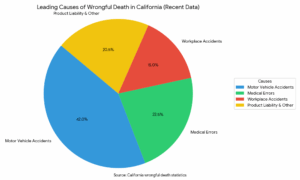
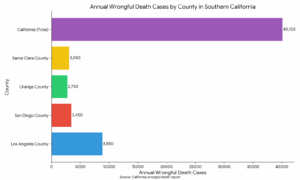
Transportation incidents are the leading cause of wrongful death claims in Southern California. The California Office of Traffic Safety reports that Los Angeles County alone records more than 3,000 fatal and serious injury crashes annually, the highest in the state .

High population density, congested highways like I-5 and I-405, and increased commercial trucking activity contribute to these figures. Wrongful death claims often involve passenger vehicles, pedestrians, bicyclists, and motorcyclists. Data from the National Highway Traffic Safety Administration confirms that pedestrian fatalities are disproportionately higher in urban Southern California counties compared to inland regions.

Leading Causes of Wrongful Death in California

Workplace Accidents and Construction Fatalities

Southern California’s construction, logistics, and manufacturing sectors account for a significant share of fatal workplace incidents. Cal OSHA fatality reports show that construction-related deaths remain consistently high in Los Angeles, Riverside, and San Bernardino counties .

Falls from height, struck-by incidents, and equipment failures are the most common causes. Wrongful death claims in these cases often involve third-party liability beyond workers’ compensation, such as equipment manufacturers or subcontractors. This legal distinction allows families to pursue civil damages not available through workers’ compensation death benefits.

Medical Negligence and Healthcare Errors

Medical malpractice is a documented contributor to wrongful death claims across Southern California. Peer-reviewed studies cited by the California Department of Public Health identify medical errors as a leading cause of preventable death statewide .

Southern California’s concentration of large hospital systems increases both patient volume and litigation frequency. Wrongful death lawsuits commonly allege diagnostic errors, surgical mistakes, delayed treatment, or medication errors. These cases require expert testimony and detailed medical record analysis, making them among the most complex wrongful death claims.

Wrongful Death Damages Available Under California Law

Economic Damages in Southern California Wrongful Death Cases

Economic damages compensate families for measurable financial losses. These include funeral and burial expenses, loss of financial support, and the value of household services the deceased would have provided. The California Civil Jury Instructions specify that damages must be based on evidence, not speculation.

In Southern California, higher average wages often result in higher economic damage calculations. The U.S. Bureau of Labor Statistics confirms that median household income in counties like Orange and Los Angeles exceeds many inland California regions . This income data directly influences lost earnings calculations in wrongful death cases.

Non-Economic Damages and Recent Legal Changes

Non-economic damages cover loss of companionship, emotional support, and guidance. Historically, California barred recovery for a decedent’s pain and suffering in wrongful death cases. However, Senate Bill 447 temporarily allows recovery of pain and suffering damages in certain cases through 2026.

This change has significantly impacted wrongful death litigation strategy in Southern California courts. Legal analysts note increased settlement values where pain and suffering evidence is admissible . Families must still meet evidentiary requirements, and courts apply these damages cautiously.

Punitive Damages and Their Limitations

Punitive damages are generally not available in wrongful death claims unless pursued through a related survival action. California law requires proof of malice, oppression, or fraud. Southern California courts apply this standard narrowly, typically in cases involving drunk driving or egregious corporate misconduct.


Southern California Wrongful Death Settlement Data and Trends

Average Settlement Ranges Based on Statewide Case Data

Analysis of over 900 California wrongful death cases shows that settlement values vary widely depending on liability strength and damages evidence. LawLinq’s statewide dataset reports an average settlement of approximately $973,000, with a median closer to $295,000 .

Southern California cases often exceed the median due to higher wage data and juror demographics. However, courts caution that no settlement is guaranteed, and outcomes depend heavily on facts.

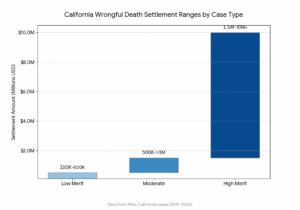
Case Strength Typical Settlement Range
Lower Liability $100,000 to $500,000
Moderate Liability $500,000 to $1.5 million
High Liability $1.5 million to $10 million plus

Annual Wrongful Death Cases by County in Southern California

Trial Outcomes and Plaintiff Success Rates

Judicial analyses indicate that plaintiffs prevail in approximately 58 to 63 percent of wrongful death trials statewide, a higher rate than many other personal injury claims . Southern California juries tend to scrutinize liability evidence closely but award damages consistent with statutory guidance.

These statistics highlight why experienced wrongful death lawyers focus heavily on early investigation, expert testimony, and venue-specific trial preparation.

How Southern California Wrongful Death Lawyers Handle Cases

Investigation, Evidence Collection, and Expert Analysis

Wrongful death lawyers in Southern California begin with a detailed investigation, often coordinating with accident reconstructionists, medical experts, and economists. This workflow aligns with best practices recommended by the American Bar Association for complex tort litigation.

First-hand experience shows that early evidence preservation is critical in traffic and workplace cases, particularly where surveillance footage or vehicle data recorders are involved.

Negotiation, Litigation, and Court-Specific Strategy

Southern California superior courts manage heavy civil caseloads. Attorneys must tailor litigation strategy to local rules and jury pools. Los Angeles County, for example, has specialized civil court divisions that influence scheduling and discovery timelines.

Settlement negotiations often occur after expert disclosures, when liability risks become clearer. Lawyers rely on comparative verdict research and county-specific jury verdict data to evaluate offers realistically.

California Wrongful Death Settlement Ranges by Case Type

Choosing the Right Southern California Wrongful Death Lawyer

Credentials, Experience, and Case Focus

Families should evaluate a lawyer’s experience with wrongful death litigation specifically, not just general personal injury cases. State Bar of California records allow verification of licensing and disciplinary history, supporting informed decision-making .

Transparency, Communication, and Client Trust

rust is built through clear communication, realistic expectations, and documented case strategy. Ethical guidelines from the California Rules of Professional Conduct require attorneys to explain fee structures and litigation risks openly.


Author and Editorial Review

Reviewed by:

A California-licensed civil litigation attorney with experience in wrongful death and catastrophic injury cases, familiar with Southern California superior courts and statutory frameworks.

Editorial Standards:

This article was fact-checked using government, judicial, and peer-reviewed sources. Data reflects publicly available reports as of the most recent update and may change with new legislation or court rulings.


Final Note for You

Wrongful death claims are legally complex and emotionally challenging. Laws, deadlines, and damages vary based on facts and jurisdiction. This guide provides research-based information, not legal advice. Families should consult qualified Southern California wrongful death lawyers to evaluate their specific situation.

You’ve survived the crash, but in many ways, the real battle is just beginning. Did you know that a single, seemingly polite conversation with an insurance adjuster can devalue your entire injury claim by thousands of dollars? Most accident victims understandably believe that insurance companies are there to help them cover their bills. However, their adjusters are trained negotiators whose primary goal is to minimize payouts, often using your own words against you and capitalizing on common insurance claim mistakes.

This guide is designed to expose those traps and explain the hidden factors that maximize settlement value. We will detail the personal injury claim process and show how partnering with an experienced car accident attorney at Kohan & Bablove protects your right to the full car accident injury compensation you deserve.

Mistake #1: Believing the Insurance Adjuster is Your Friend

One of the most costly insurance claim mistakes an accident victim can make is assuming the other driver’s insurance adjuster is on their side. Adjusters are employees of the insurance company, and their primary job is to protect the company’s financial interests by minimizing payouts. They are trained negotiators who often use a friendly and concerned demeanor to gain your trust, but their goal is to find reasons to devalue or deny your claim.

The Psychology Behind the “Recorded Statement” Trap

You will likely get a call from an adjuster asking for a recorded statement to “hear your side of the story.” This is a calculated tactic. They ask leading questions designed to get you to downplay your injuries (“So you’re feeling a bit better today?”) or unintentionally admit partial fault. Never give a recorded statement without legal counsel present. An experienced car accident lawyer knows how to handle these communications to protect your rights.

“I’m Sorry” and Other Phrases That Imply Fault

A simple, polite “I’m sorry” at the scene or on the phone can be twisted into a direct admission of liability. Even if you were just expressing sympathy, an insurance company will use this phrase as evidence that you believe you caused the crash. It is critical to stick to the facts and avoid making any statements that could be misinterpreted as accepting blame.

The Danger of Signing a Medical Release Form Too Early

The adjuster may also ask you to sign a medical release form to verify your injuries. The danger is that these forms are often deceptively broad, giving the insurer access to your entire medical history. They will search for any pre-existing condition, even from 10 years ago, to argue that your current pain is not from the accident. This can severely damage your claim for car accident injury compensation.

Of course. Here are the next three sections, written to your exact specifications and word counts.

Mistake #2: Accepting the First Settlement Offer (The “Quick Check” Trap)

Shortly after an accident, you may receive a call from an adjuster offering a quick check to “help with your bills.” This is a classic trap and one of the most damaging insurance claim mistakes you can make. The offer may seem tempting when you’re facing immediate expenses, but it is a calculated tactic designed to close your case for a fraction of its true value. Insurance companies know that unrepresented victims are more likely to accept a lowball offer out of desperation.

Immediate Needs vs. Long-Term Care

Early settlement offers are intentionally small. They might cover your initial emergency room visit or the cost of a rental car, but they almost never account for the full scope of your long-term needs. True car accident injury compensation includes future physical therapy, specialist appointments, potential surgeries, prescription costs, and wages lost from time off work. These costs can add up to tens or even hundreds of thousands of dollars, leaving you with a massive financial burden if you settle too early.

Understanding Maximum Medical Improvement (MMI)

People often ask: “When should I settle my car accident claim?” The answer from any experienced car accident lawyer is clear: not before you have reached Maximum Medical Improvement (MMI). MMI is the point where your doctor determines that your condition has stabilized and is unlikely to improve further. Only then can you and your legal team understand the full, long-term impact of your injuries and accurately calculate your total damages to maximize settlement value.

Once You Sign, It’s Over

When you accept a settlement, you will be required to sign a release form. This is a legally binding document that permanently ends your claim. You cannot come back and ask for more money, even if your injuries turn out to be more severe than you thought or require unexpected surgery down the road. The insurance company’s file is closed forever, and you are left to handle any future costs on your own.

Mistake #3: Ignoring the “Gap in Treatment” Red Flag

In the chaotic aftermath of a crash, it’s common to think your aches and pains will simply go away. Delaying medical care is a serious error that insurance companies are quick to exploit. Any significant delay, or “gap in treatment,” between the accident and your first doctor’s visit gives the adjuster a powerful argument to devalue or deny your claim. This is a critical part of the personal injury claim process that you must get right.

The “Adrenaline Mask”

Immediately after a collision, your body is flooded with adrenaline. This “fight or flight” response can mask serious pain for hours or even days. You might walk away from the scene feeling shaken but fine, only to wake up the next morning in severe pain. This is why seeing a doctor right away is crucial, not just for your health, but to create a time-stamped medical record that proves your injuries are linked to the crash.

How Insurance Companies Weaponize Delays

If you wait even a few days to see a doctor, the insurance adjuster will argue that your injuries must not be that serious. Worse, they will suggest that something else must have happened during that “gap” to cause your injury, and therefore, they are not responsible for it. They weaponize these delays to create doubt and justify denying your claim for car accident injury compensation.

Documenting the Invisible Damages

Consistent medical treatment is also essential for proving your non-economic damages. These are the “invisible” injuries like chronic pain, emotional distress, anxiety, and PTSD that significantly impact your quality of life. A detailed record from doctors, therapists, and other specialists provides the official documentation needed to demonstrate the full extent of your suffering and helps your car accident attorney fight for the compensation you deserve for it.

The Kohan & Bablove Advantage: Aggressive Representation for Serious Injuries

When you’re facing a powerful insurance corporation, you need an equally powerful advocate on your side. The right car accident attorney does more than just file paperwork; they build a formidable case designed to maximize settlement value and hold negligent parties accountable. At Kohan & Bablove, our entire approach is built on aggressive, strategic representation that forces insurance companies to take your claim seriously.

Car Accident Lawyers in Orange county

We Don’t Just Settle; We Prepare for Trial

Many firms are “settlement mills” that aim to resolve cases quickly for a lower value. We operate differently. From day one, we prepare every case as if it is going to trial. This reputation for being aggressive litigators sends a clear message to insurance companies: we will not accept lowball offers. This willingness to fight in court often forces them to offer significantly fairer settlements during negotiations because a trial is expensive and risky for them.

Calculating the True Value of Your Case

An insurance adjuster will never tell you what your claim is really worth. We uncover the true value by working with a network of respected experts. Medical specialists help us project future treatment needs, vocational experts assess your lost earning capacity, and economists calculate the total financial impact of your injuries over a lifetime. This data-driven approach allows us to demand the full car accident injury compensation you are owed.

No Recovery, No Fee Promise

We believe everyone deserves access to premier legal defense, regardless of their financial situation. That is why Kohan & Bablove operate on a contingency fee basis. You pay absolutely nothing upfront. We cover all the costs of building your case, and we only receive a fee if we successfully win or settle your claim. This no-risk promise ensures our goals are perfectly aligned with yours: securing the best possible outcome.

A car accident claim is far more than an exchange of insurance details; it involves complex laws and predatory insurance tactics designed to minimize your recovery. As this guide has shown, trying to handle the personal injury claim process alone exposes you to costly insurance claim mistakes that put your financial future at serious risk. Don’t let a simple error made today haunt you for years to come as you struggle with medical bills and lost income.

Have you been injured in a car accident? Before you sign anything and before you speak to the adjuster, take the most important step to protect yourself. Contact the experienced car accident attorneys at Kohan & Bablove today for a free, confidential case evaluation. Let us protect your rights and fight to maximize your compensation.


After a serious injury, medical bills pile up and income often stops. The last thing you should worry about is how to afford a great personal injury lawyer. This is why Demystifying the Contingency Fee agreement exists; a system designed to give everyone access to justice. A contingency fee personal injury lawyer allows injury victims to hire experienced legal representation without paying any upfront costs.

At Kohan & Bablove Injury Attorneys, we operate on a simple principle: “No Fees Until We Win.” This means you pay nothing upfront for our legal services. Our fee is a pre-agreed percentage of the final settlement we secure for you. If we don’t win your case, you owe us no attorney’s fees. It’s that simple.

What is a Contingency Fee Agreement?

A contingency fee agreement is a powerful tool for justice that levels the playing field between an injured individual and a large insurance company. Working with a contingency fee personal injury lawyer means your attorney only gets paid if you recover compensation. It is a financial partnership between you and your personal injury lawyer, built on a shared goal: to win your case. This arrangement removes the financial barriers that might otherwise prevent you from hiring a top-tier attorney. At its heart is the simple, powerful promise that has become our motto at Kohan & Bablove Injury Attorneys: “No Fees Until We Win.”

Defining the Attorney-Client Financial Arrangement

Unlike firms that charge steep hourly rates regardless of the outcome, a contingency fee arrangement means our attorney’s fee is a pre-agreed percentage of the money we successfully recover for you. The fee is contingent or dependent on our securing a financial settlement or a winning court verdict on your behalf. This transparent structure ensures our interests are perfectly aligned with yours. If you don’t get paid, we don’t get paid. It’s a performance-based model where we are rewarded only when we deliver results for you.

You Pay Nothing Upfront for Our Time or Resources

With a contingency fee agreement, you will never have to pay a retainer or any out-of-pocket costs to get your case started. Kohan & Bablove Injury Attorneys advances all the necessary expenses to build a powerful case. This includes costs for hiring expert witnesses, court filing fees, investigation expenses, and deposition transcripts. We invest our own time and resources into your case because we believe in it. This means you take on zero financial risk, allowing you to focus completely on your recovery while we focus on fighting for you.

How Does It Work in Practice?

The contingency fee model is designed to be straightforward and transparent, ensuring you understand exactly how your legal representation is financed from day one. At Kohan & Bablove Injury Attorneys, we believe this arrangement builds trust and aligns our goals directly with yours. Let’s break down the practical steps of our “No Fees Until We Win” commitment.

We Are Paid a Percentage of the Settlement or Verdict

When you partner with us, we agree on a specific percentage that will serve as our attorney’s fee. This percentage is taken from the total amount of money we secure for you, whether through a negotiated settlement with an insurance company or a winning verdict in court. The exact percentage is clearly outlined in our written agreement before we begin any work, so there are never any surprises. This means we are only paid when we successfully deliver a financial recovery for you.

If We Don’t Win Your Case, You Owe Us No Attorney’s Fees

This is the core of our promise to you. If, for any reason, we are unable to win your case and do not recover any money on your behalf, you owe us absolutely nothing for our time or legal services. We assume all the risk of investing our resources and expertise into your case. This demonstrates our confidence in the cases we accept and ensures you are never in a worse financial position for seeking justice.

Explaining Case Costs (Filing Fees, Expert Witnesses)

It’s important to distinguish between “attorney’s fees” (payment for our work) and “case costs.” Case costs are the out-of-pocket expenses required to build a strong case. These can include court filing fees, charges for obtaining medical records, fees for expert witnesses (like accident reconstructionists or medical specialists), and costs for depositions. As part of our contingency fee agreement, our firm advances all of these costs for you. They are then typically reimbursed to the firm out of the final settlement amount. Our agreement details this process transparently.

The Benefits of the Contingency Fee Model for You

The contingency fee model is more than just a payment plan; it is a system designed entirely around your best interests. It provides you with immediate access to a top-tier attorney and offers several powerful advantages that empower you throughout your personal injury claim. This client-first approach is why our firm, Kohan & Bablove Injury Attorneys, stands firmly by our promise of “No Fees Until We Win.”

It Levels the Playing Field Against Large Insurance Companies

Insurance corporations have vast financial resources and teams of experienced lawyers dedicated to minimizing their payouts. An individual trying to fight them alone is at an immediate and overwhelming disadvantage. The contingency fee model eliminates this imbalance. It allows you to hire a powerful legal team right away, without any upfront cost, giving you the same legal firepower as the opposition. Your case is taken seriously from day one because the insurance company knows you have a skilled professional fighting for you.

It Motivates Your Attorney to Maximize Your Compensation

Because your attorney’s payment is a percentage of the money you receive, their financial success is directly tied to yours. This creates a powerful, shared incentive to fight for the maximum possible compensation, not just a quick and easy settlement. Your personal injury lawyer is motivated to uncover every category of damage, from future medical needs and lost earning capacity to the full extent of your pain and suffering. Our goal is your goal: to secure the best possible outcome.

Contingency Fees Encourage Full Case Investigation

Because the attorney’s payment depends on the final recovery, law firms are incentivized to leave no stone unturned. This means they are motivated to hire expert witnesses, gather all necessary medical and financial documentation, and investigate liability thoroughly, ensuring your case is as strong as possible. The contingency model aligns the lawyer’s effort with your best interests.

It Signals the Attorney’s Confidence in Your Case

When a law firm like Kohan & Bablove Injury Attorneys accepts your case on a contingency fee, it is a powerful vote of confidence. We are investing our own time, money, and resources into pursuing your claim because we believe it has merit and that we can be successful. Our “No Fees Until We Win” policy isn’t just a slogan; it’s a reflection of our professional assessment and our commitment to you. This should give you peace of mind, knowing that an experienced legal team believes in your case.

Our Commitment at Kohan & Bablove is to Your Success

At Kohan & Bablove Injury Attorneys, our commitment to your success is more than just a phrase; it is the entire foundation of our practice. Our contingency fee agreement is our promise that you will never have to worry about the cost of hiring a top-tier attorney. We believe your focus should be on your recovery, not on legal bills. Choosing a contingency fee personal injury lawyer ensures you can pursue justice without financial risk.

Your success becomes our mission. We invest our own resources, time, and expertise into your case because we are confident in our ability to fight for you and win. This model ensures our goals are perfectly aligned and motivates us to secure the absolute best outcome for you and your family. This is the essence of “No Fees Until We Win.” It’s our pledge to you: we only succeed when you do.

For many pursuing a personal injury claim, the word “deposition” can sound intimidating. If your case proceeds to the litigation phase, this step is almost unavoidable. So, what is it? A deposition is a formal question-and-answer session where you provide sworn testimony outside of a courtroom. The other side’s attorney will ask you about the accident and your injuries, and your answers are recorded.

The idea of facing personal injury deposition questions can be nerve-wracking, but it doesn’t have to be. At Kohan & Bablove Injury Attorneys, a core part of our job is preparing for a deposition with you.

This guide will demystify the process, explaining what to expect during a deposition so you can enter the room with confidence, prepared to share your story clearly and truthfully.

Introduction: What is a Deposition and What is its Purpose?

A deposition is a key part of the “discovery” phase of a lawsuit. It is a formal, out-of-court proceeding where you, the plaintiff (also called the deponent), answer questions asked by the opposing party’s attorney. This deposition testimony is given under oath, which means it has the same legal weight as testimony given in a courtroom.

A court reporter will be present to record everything that is said, creating an official written transcript.

The primary purpose of a deposition is for the opposing counsel to gather information. They want to know what you will say at trial. It gives them a chance to understand the facts of the case from your perspective, evaluate your credibility as a witness, and “lock in” your story.

They will ask a wide range of personal injury deposition questions about the accident, your injuries, and how your life has been affected. While it is a formal legal proceeding, it is also a standard step in nearly every personal injury case that enters litigation.

A crucial part of preparing for a deposition with your personal injury lawyer is understanding that its main function is information gathering for the other side—it is not a time to argue your case.

The Key Players in the Room

When you walk into the room for your deposition, you will see a few key people at the conference table. Understanding who they are and what their roles are is the first step in knowing what to expect during a deposition.

It helps demystify the process and makes it feel less like an interrogation and more like the structured legal proceeding it is.

You (The Deponent)

As the person bringing the lawsuit, you are the deponent. Your role is simple but crucial: to answer the questions asked of you truthfully and accurately.

You are the star witness of your own case, and your testimony is the central focus of the day.

Your Attorney

Your personal injury lawyer from Kohan & Bablove will be sitting right beside you. Their role is to protect you.

They will ensure the opposing attorney’s questions are fair and appropriate. If a question is improper, your lawyer will object. They cannot answer questions for you, but their presence ensures the rules are followed and you are not taken advantage of.

The Opposing Counsel

This is the attorney representing the defendant (the person or company you are suing). Their job is to ask you questions to discover the facts and assess the strengths and weaknesses of your case.

They will be professional, but it’s important to remember they represent the other side’s interests, not yours.

The Court Reporter

The court reporter is a neutral party responsible for creating an official, word-for-word record of your sworn testimony.

They will administer the oath at the beginning and record every question, answer, and objection. Because they are typing everything that is said, it is vital to speak clearly and avoid speaking over others.

The Rules of a Deposition

A deposition has its own set of rules and best practices. Following them is essential for giving clear, effective testimony and protecting your case.

Your attorney will spend significant time preparing for a deposition with you, and a large part of that preparation will focus on these fundamental principles. Mastering them is key to successfully navigating the process.

You Are Under Oath

The first thing that will happen is the court reporter will ask you to raise your right hand and swear to tell the truth. This oath is legally binding.

Your deposition testimony has the same force as if you were in a courtroom testifying before a judge and jury. The single most important rule is to be truthful. Never guess, speculate, or make up an answer.

If you don’t know the answer, “I don’t know” is a perfectly acceptable and complete response.

Answering a Question vs. Volunteering Information

This is perhaps the most critical rule to remember. Listen carefully to the question asked, and answer only that question.

Do not volunteer extra information, offer explanations, or try to “help” the opposing attorney understand something. If they ask a “yes” or “no” question, answer with “yes” or “no” if you can.

Providing extra details can open up new, unwanted lines of questioning and potentially harm your case.

The Importance of Pausing Before You Answer

Before answering any question, take a moment to pause. This brief pause accomplishes two vital things.

First, it gives you time to make sure you fully understand the question being asked. Second, and just as importantly, it gives your attorney a chance to object if the question is improper (for example, if it is confusing or asks for privileged information).

Once you start answering, it’s too late for your lawyer to object. This simple habit of pausing is a powerful tool.

Common Questions You Will Be Asked

While no two depositions are identical, the personal injury deposition questions you’ll face will generally fall into four main categories.

Knowing what to expect during a deposition helps reduce anxiety and allows you to focus on providing truthful, accurate answers. Your attorney will review these areas with you in detail as you are preparing for a deposition.

Your Background

The opposing attorney will start with simple, straightforward questions to get basic information and help you get comfortable with the process.

They will ask for your full name, date of birth, address, educational background, and employment history. This part is usually low-stress and serves to establish a baseline.

The Details of the Accident

This is the core of the deposition. You will be asked to describe, in your own words, exactly how the accident happened.

Expect questions about the date, time, and location; what you were doing right before the incident; what you saw, heard, and felt; and any conversations you had with other parties or witnesses at the scene.

They will want a step-by-step account of the event.

Your Injuries, Treatment, and Recovery

The attorney will spend significant time asking about your injuries. You will be asked to describe every injury you sustained, from head to toe.

They will ask about your medical history before the accident to see if there are any pre-existing conditions. You will also be asked to list every doctor, physical therapist, and hospital you have visited since the accident, as well as describe the treatments you received and your current level of pain.

How the Injuries Have Impacted Your Life

This category of questions focuses on your “damages.” The attorney will ask how your injuries have affected your daily life.

This includes your ability to work, perform household chores, engage in hobbies, and participate in social or family activities. This is where your sworn testimony helps establish the basis for your pain and suffering claim.

How Kohan & Bablove Prepares You to Succeed in Your Deposition

At Kohan & Bablove Injury Attorneys, we understand that a deposition can be the most intimidating part of your claim. That’s why we never let our clients face it unprepared.

A crucial part of our role as your personal injury lawyer is preparing for a deposition with you in detailed, one-on-one sessions. We will walk you through the entire process, explaining exactly what to expect, from the room’s layout to the types of questions you will face.

We will review the facts of your case, practice answering common personal injury deposition questions, and drill the most important rules, like pausing before answering.

Our goal is to demystify the experience so you can walk in feeling confident and protected, ready to provide clear, truthful, and effective deposition testimony that strengthens—rather than harms—your case.

Frequently Asked Questions About Depositions

Facing a deposition can be a source of anxiety for many plaintiffs. To help ease your concerns, we have answered five of the most common questions our clients ask about the process.

This information is a starting point for the detailed preparation your personal injury lawyer will provide.

1. Is a deposition always necessary for a personal injury claim?

No, not all claims require a deposition. A deposition only happens if a lawsuit has been filed and the case enters the “discovery” phase of litigation.

Many cases are settled with the insurance company before a lawsuit is ever filed. However, if your case does proceed to litigation, a deposition is a standard and almost certain step.

2. How long will my deposition take?

There is no fixed time, as it depends on the complexity of your case. For a relatively straightforward car accident, a deposition might last two to four hours.

For more complex cases involving severe injuries or multiple parties, it could take a full day or even longer, spread across multiple sessions. Your attorney will be by your side for the entire duration.

3. What should I do if I don’t remember the answer to a question?

It is perfectly acceptable and correct to say, “I don’t remember” or “I don’t know.” This is a complete and truthful answer.

You are under oath to tell the truth, and the truth may be that you do not recall a specific detail. Never guess, estimate, or make something up. A simple “I don’t remember” is far better for your case than an inaccurate answer.

4. What happens if I realize I made a mistake in my testimony?

It is human to make mistakes. If you realize you said something incorrect, tell your lawyer immediately—even during a break.

Your attorney can put a correction on the record. You will also have a chance to review the written transcript of your deposition testimony for accuracy and make any necessary corrections in writing before you sign it.

5. What happens to my deposition testimony after it’s over?

After the deposition, the court reporter will create a formal written transcript. This sworn testimony becomes a permanent part of your case record.

The opposing attorney will use it to evaluate your claim for settlement purposes. If your case proceeds to trial, either side may use your deposition transcript to ask you questions and to ensure your testimony remains consistent.

What is my personal injury claim worth in California? The answer depends on several key factors, including the total economic and non-economic damages you have suffered. After an injury, one of the most pressing questions is, “What is my personal injury claim worth?” While there is no simple formula, the answer lies in calculating damages in California, the total losses you have suffered. This includes tangible costs like medical bills and lost wages, as well as the non-economic impact, such as pain and suffering.

Every case is unique, and understanding your potential injury compensation requires a careful evaluation of the specific facts. This guide from Kohan & Bablove Injury Attorneys will break down the key factors that determine the value of a claim.

Calculating Economic Damages (Special Damages)

The foundation of determining what your personal injury claim is worth lies in adding up all of your tangible, financial losses. In legal terms, these are called “economic damages” or “special damages.” They represent every dollar you have lost or will have to spend because of the accident. A crucial part of calculating damages in California involves meticulously documenting each of these costs to ensure you receive full and fair injury compensation. When reviewing medical bills, lost income, and future expenses, these numbers form the foundation for determining what your personal injury claim is worth. If your injuries resulted from a serious accident, you can learn more about your legal rights on our personal injury attorney page. 

Current and Future Medical Expenses

This is often the largest component of economic damages. It begins with the initial emergency room visit, ambulance ride, and hospitalization costs. However, it must also include all anticipated future medical care. This could involve follow-up surgeries, ongoing physical or occupational therapy, prescription medications, specialist consultations, and even in-home nursing care. For serious injuries, projecting these future costs with the help of medical experts is essential to understanding the true value of your claim.

Lost Wages and Income

If you were unable to work while recovering, you are entitled to compensation for the income you lost. This is calculated based on your regular salary or hourly wage, but it also includes any missed overtime, commissions, bonuses, or other benefits you would have earned had you not been injured. Proving this loss typically involves providing pay stubs, employment records, and sometimes a letter from your employer.

Loss of Future Earning Capacity

For victims with permanent or long-term disabilities, this category is critically important. It is different from lost wages. “Loss of future earning capacity” represents the money you will be unable to earn over the rest of your working life because your injuries prevent you from returning to your previous job or working at all. Accurately calculating this massive loss often requires analysis from vocational experts and economists to determine its full value.

Property Damage and Other Out-of-Pocket Costs

This category includes the cost of repairing or replacing any property damaged in the accident, most commonly your vehicle in a car crash. It also covers other direct expenses you incurred, such as rental car fees, the cost of crutches or other medical equipment, and even mileage costs for traveling to and from your doctor’s appointments. No expense is too small to be included in the final calculation.

Understanding Non-Economic Damages (General Damages)

While economic damages cover the financial foundation of your claim, they don’t tell the whole story. The true impact of an injury goes far beyond bills and lost paychecks. This is where “non-economic damages,” also known as general damages, come into play. They are intended to compensate you for the profound, intangible, human cost of the harm you have suffered. When calculating damages in California, this component is often the most significant factor in determining what your personal injury claim is worth, as it addresses the real-life consequences of the injury. Pain, suffering, and emotional distress often play a major role in deciding what your personal injury claim is worth in California.

Pain and Suffering

This is the most well-known category of non-economic damages. It refers directly to the physical pain, discomfort, and general suffering you have endured because of your injuries. This includes the pain from the initial impact, the discomfort of medical treatments and surgeries, and any chronic pain you may be left with. The severity of your injuries, the intensity of the pain, and the duration of your recovery all heavily influence the value assigned to this element of your claim.

Emotional Distress and Mental Anguish

Beyond the physical toll, a serious accident inflicts a heavy emotional and psychological burden. This category provides injury compensation for the mental anguish you experience. This can manifest as anxiety, fear, depression, shock, humiliation, insomnia, or even Post-Traumatic Stress Disorder (PTSD). For example, a car accident victim may develop a debilitating fear of driving. These are very real and compensable harms that must be properly accounted for when valuing a claim.

Loss of Enjoyment of Life

This damage category addresses a fundamental question: How has the injury taken away the joys of your daily life? It refers to your inability to participate in activities and hobbies that you loved before the accident. This could be the inability to play with your children, go for a run, work in your garden, play a musical instrument, or engage in social activities. It demonstrates how the injury has diminished your overall quality of life, a significant loss that deserves compensation.

Loss of Consortium (for spouses)

This is a unique and important claim that can be brought by the spouse or registered domestic partner of the injured person. It is not compensation for the injured victim, but for the spouse who has been deprived of their partner’s love, companionship, comfort, affection, moral support, and intimate relations as a result of the injury. The law recognizes that when one spouse is seriously injured, the marital relationship suffers a profound loss, and the uninjured spouse deserves to be compensated for that harm.

How Factors Like Comparative Negligence Affect Your Settlement

After calculating damages in California, it’s important to understand that the total value is not always what you receive. Certain legal principles can reduce your final injury compensation. The most significant of these is California’s “pure comparative negligence” rule. Understanding how fault impacts compensation is essential when determining what your personal injury claim is worth. California follows a pure comparative negligence system under California Civil Code Section 1431.2.


This rule means you can still recover damages even if you were partially at fault for the accident. However, your final award will be reduced by your percentage of blame. For example, if your total damages are calculated to be $100,000, but a court determines you were 25% responsible for the crash (perhaps for being slightly distracted), your final recovery would be reduced by 25% ($25,000), leaving you with $75,000.

Because of this, insurance companies will fight to place as much fault on you as possible to reduce their payout. A critical job for the attorneys at Kohan & Bablove Injury Attorneys is to use evidence to minimize your percentage of fault and protect the full value of your personal injury claim is worth. Other factors, like the at-fault party’s insurance policy limits, can also cap the final amount you are able to recover.

Let Kohan & Bablove Provide a Professional Case Valuation

As this guide shows, trying to determine what your personal injury claim is worth is far more complex than a simple calculation. Online settlement calculators can be misleading and rarely account for the full, long-term impact of an injury or the nuances of calculating damages in California. The only way to get an accurate understanding of your potential recovery is to speak with a legal professional who can evaluate the unique details of your case. Understanding what your personal injury claim is worth requires a careful review of both financial and personal losses.

If you are wondering what your personal injury claim is worth, a professional case evaluation is the only reliable way to get an accurate answer. The dedicated team at Kohan & Bablove Injury Attorneys is here to provide that clarity. During a free, no-obligation consultation, we will listen to your story, review your medical records and other evidence, and explain the factors that contribute to your claim’s value. We will help you understand your rights and provide an honest, professional assessment of your potential injury compensation. Don’t leave your future to guesswork. Contact us today to get the experienced insight you need to make an informed decision.

Request a Consultation